
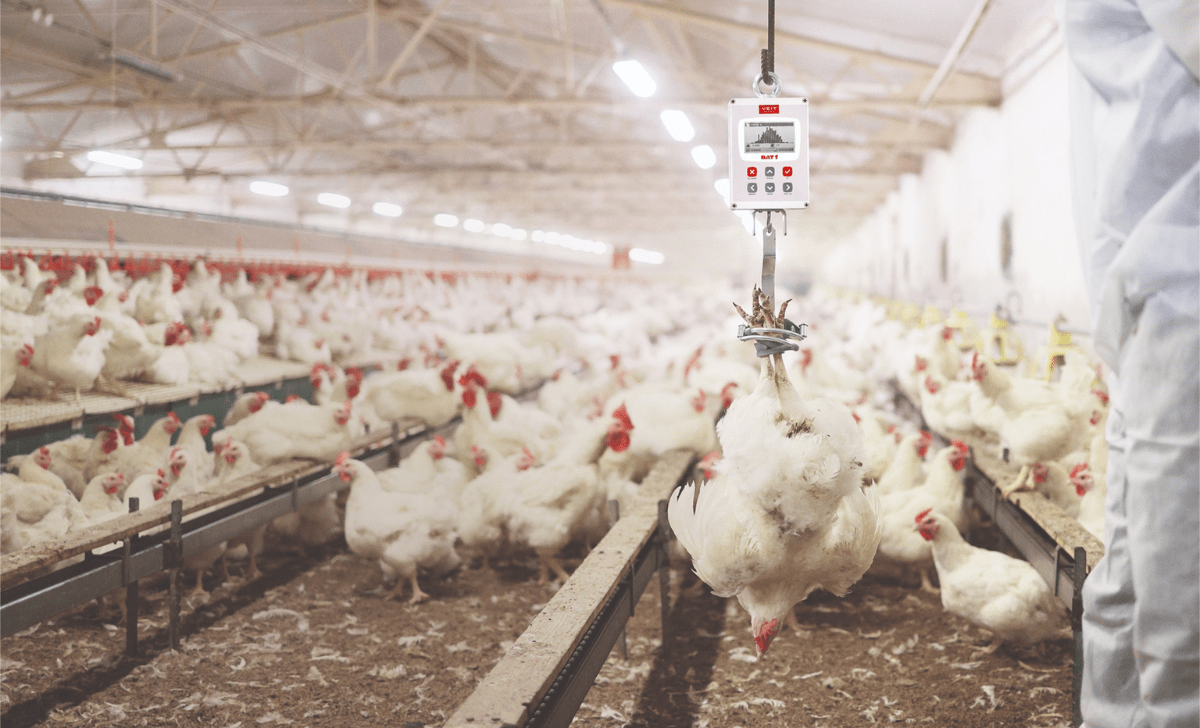
Poultry environmental factors play a critical role in determining flock success. The conditions inside a poultry house directly impact bird welfare, growth performance, and profitability. Understanding how environment affects chicken behavior enables producers to optimize their operations.
Temperature Control: The Foundation of Performance
Temperature control for chickens varies throughout their development. Young chicks cannot regulate body temperature effectively until 12 to 14 days of age (Cobb Breeder Management Guide, 2021). Chicks with cold feet show reduced activity and feed intake, directly impacting growth rates. The ideal chicken zone temperature ranges from 31°C at day one to 22°C by day 27 (Cobb Breeder Management Guide, 2021).
When poultry climate control systems fail, birds migrate to comfortable zones or huddle together. Heat stress causes panting and reduces feed consumption. Cold stress forces birds to metabolize energy for warmth rather than growth. Research shows low environmental temperature significantly affects broiler performance and blood parameters (Blahová et al., 2007).
Monitoring flock weight precisely with tools like the BAT2 Connect automatic poultry scale helps producers identify environmental problems early. Real-time data reveals when growth rates decline due to temperature issues.
Ventilation and Air Quality Management
Poultry housing ventilation systems must balance multiple objectives. They control moisture, remove harmful gases, and maintain stable temperatures. The maximum carbon dioxide level should never exceed 3,000 ppm, while oxygen must stay above 19.6% (Cobb Broiler Management Guide, 2021).
Ammonia concentration below 20 ppm is essential for bird health (Bist et al., 2023). Higher ammonia levels impair the immune system and increase respiratory disease. Studies demonstrate that ammonia exposure during rearing reduces growth rates permanently (University of Georgia Extension, 2024). Poor air quality also increases susceptibility to disease and creates welfare concerns (Cobb Broiler Management Guide, 2021).
Poultry housing environment effects extend beyond gas concentrations. Relative humidity between 50 and 70 percent minimizes ammonia production and dust levels (University of Georgia Extension, 2024). High humidity reduces thermoregulation ability during hot weather. Low humidity creates dusty conditions that irritate respiratory systems.
Lighting: More Than Illumination
Lighting effects on poultry greatly influence feed intake patterns and activity levels. Photoperiod and light intensity are key elements for maximizing growth performance (Patel et al., 2016). LED lighting systems offer superior control over traditional incandescent bulbs. They reduce energy consumption by two-thirds while providing precise light management (Oso et al., 2022).
Constant lighting in early life can induce fear-related behaviors and disrupt hippocampal gene expression (Yang et al., 2022). Variable light intensity programs improve behavioral repertoires and welfare outcomes (Kang et al., 2023). Contrast in light intensity influences chicken behavior and environment interaction more than day length alone (Blatchford et al., 2012).
Environmental Enrichment Impacts
Environmental enrichment poultry systems provide choices for birds within their housing. Elevated platforms allow species-specific behaviors and reduce pressure on footpads (Ohara et al., 2015). Enrichment elements like perches and platforms tackle inactivity, as conventional chickens remain inactive approximately 80% of the time when not eating or drinking (Weeks et al., 2000).
Research indicates enrichment improves leg health and reduces lameness (Pedersen et al., 2020). Straw bales trigger natural pecking behavior toward straw stems rather than other birds (Baxter et al., 2018). However, not every enrichment suits all production systems perfectly.
Chicken welfare environmental factors significantly outweigh stocking density concerns. Housing conditions influence welfare more than bird density alone (Dawkins et al., 2004). Birds should distribute uniformly throughout the house and remain active. Irregular distribution signals environmental problems requiring immediate investigation.
Precision Management for Optimal Growth
Achieving the optimal environment for poultry growth requires continuous monitoring. Modern technology enables real-time tracking of multiple parameters simultaneously. The BAT1 manual poultry scale provides accurate weight measurements that reveal environmental impacts on growth curves.
Poultry growth environmental impact assessment becomes easier with cloud-based data management. The BAT Cloud platform allows producers to correlate environmental conditions with performance metrics. This integration helps identify which environmental factors poultry growth most significantly.
Body weight uniformity reflects environmental management quality. Fluctuating temperatures create uneven growth patterns across flocks (Vasdal et al., 2019). Proper climate control enhances feed conversion and average daily gain. Every environmental variable interacts with others, creating complex relationships that determine production outcomes.
The poultry growth environmental impact extends from hatch to slaughter. Small decreases in feed intake during brooding lead to significant productivity losses (Cobb Broiler Management Guide, 2021). Environmental challenges during early development cannot be fully recovered later. This emphasizes why precise environmental control matters most during critical growth phases.
References
Baxter, M., Bailie, C.L., & O’Connell, N.E. (2018). Evaluation of dustbathing substrate and straw bales as environmental enrichments in commercial broiler housing. Applied Animal Behaviour Science, 200, 78-85. https://doi.org/10.1016/j.applanim.2017.11.010
Bist, R.B., Subedi, S., Chai, L., & Yang, X. (2023). Ammonia emissions, impacts, and mitigation strategies for poultry production: A critical review. Journal of Environmental Management, 328, 116919. https://doi.org/10.1016/j.jenvman.2022.116919
Blahová, J., Dobšíková, R., Straková, E., & Suchý, P. (2007). Effect of low environmental temperature on performance and blood system in broiler chickens (Gallus domesticus). Acta Veterinaria Brno, 76, 17-23. https://doi.org/10.2754/avb200776010017
Blatchford, R.A., Archer, G.S., & Mench, J.A. (2012). Contrast in light intensity, rather than day length, influences the behavior and health of broiler chickens. Poultry Science, 91, 1768-1774. https://www.sciencedirect.com/science/article/pii/S0032579119396221
Cobb Breeder Management Guide. (2021). Cobb-Vantress Inc. https://www.cobb-vantress.com
Cobb Broiler Management Guide. (2021). Cobb-Vantress Inc. https://www.cobb-vantress.com
Dawkins, M., Donnelly, D.A., & Jones, T.A. (2004). Chicken welfare is influenced more by housing conditions than by stocking density. Nature, 427, 342-344. https://doi.org/10.1038/nature02226
Kang, S.W., Christensen, K.D., Kidd, M.T., Jr., Orlowski, S.K., & Clark, J. (2023). Effects of a variable light intensity lighting program on the welfare and performance of commercial broiler chickens. Frontiers in Physiology, 14, 1059055. https://doi.org/10.3389/fphys.2023.1059055
Ohara, A., Oyakawa, C., Yoshihara, Y., Ninomiya, S., & Sato, S. (2015). Effect of environmental enrichment on the behavior and welfare of Japanese broilers at a commercial farm. Journal of Poultry Science, 52, 323-330. https://www.sciencedirect.com/science/article/pii/S0003909825002553
Oso, O.M., Metowogo, K., Oke, O.E., & Tona, K. (2022). Evaluation of light emitting diode characteristics on growth performance of different poultry species: A review. World’s Poultry Science Journal, 78, 337-351. https://www.tandfonline.com/doi/abs/10.1080/00439339.2022.2007509
Patel, S.J., Patel, A.S., Patel, M.D., & Patel, J.H. (2016). Significance of light in poultry production: A review. Advances in Life Sciences, 5, 1154-1160.
Pedersen, I.J., Tahamtani, F.M., Forkman, B., Young, J.F., Poulsen, H.D., & Riber, A.B. (2020). Effects of environmental enrichment on health and bone characteristics of fast growing broiler chickens. Poultry Science, 99, 1946-1955. https://doi.org/10.1016/j.psj.2019.11.061
University of Georgia Extension. (2024). Environmental factors to control when brooding chicks. The Poultry Site. https://www.thepoultrysite.com/articles/environmental-factors-to-control-when-brooding-chicks-1
Vasdal, G., Granquist, E.G., Skjerve, E., de Jong, E.I.C., Berg, C., Michel, V., & Oppermann Moe, R. (2019). Associations between carcass weight uniformity and production measures on farm and at slaughter in commercial broiler flocks. Poultry Science, 98, 4261-4268. https://doi.org/10.3382/ps/pez233
Weeks, C.A., Danbury, T.D., Davies, H.C., Hunt, P., & Kestin, S.C. (2000). The behaviour of broiler chickens and its modification by lameness. Applied Animal Behaviour Science, 67, 111-125. https://doi.org/10.1016/S0168-1591(99)00102-1
Yang, Y., Cong, W., Liu, J., Zhao, M., Xu, P., Han, W., Wang, D., & Zhao, R. (2022). Constant light in early life induces fear-related behavior in chickens with suppressed melatonin secretion and disrupted hippocampal expression of clock- and BDNF-associated genes. Journal of Animal Science and Biotechnology, 13, 67. https://www.sciencedirect.com/science/article/pii/S1568163723002532