
Weight subpopulations and welfare divergence
Automated weighing systems have transformed data collection on commercial poultry farms, but weight data alone does not tell the full story of flock health. Research by Sibanda et al. (2020) demonstrated that different weight subpopulations within the same flock can exhibit significantly different welfare, health, and production statuses. In a study of Australian commercial free-range laying hens housed in an aviary system, body weight subpopulations were associated with measurable differences in welfare outcomes and egg production performance. These distinctions are not visible in aggregated weight data. They require direct, hands-on evaluation of individual birds.
The case for physical assessment during weighing
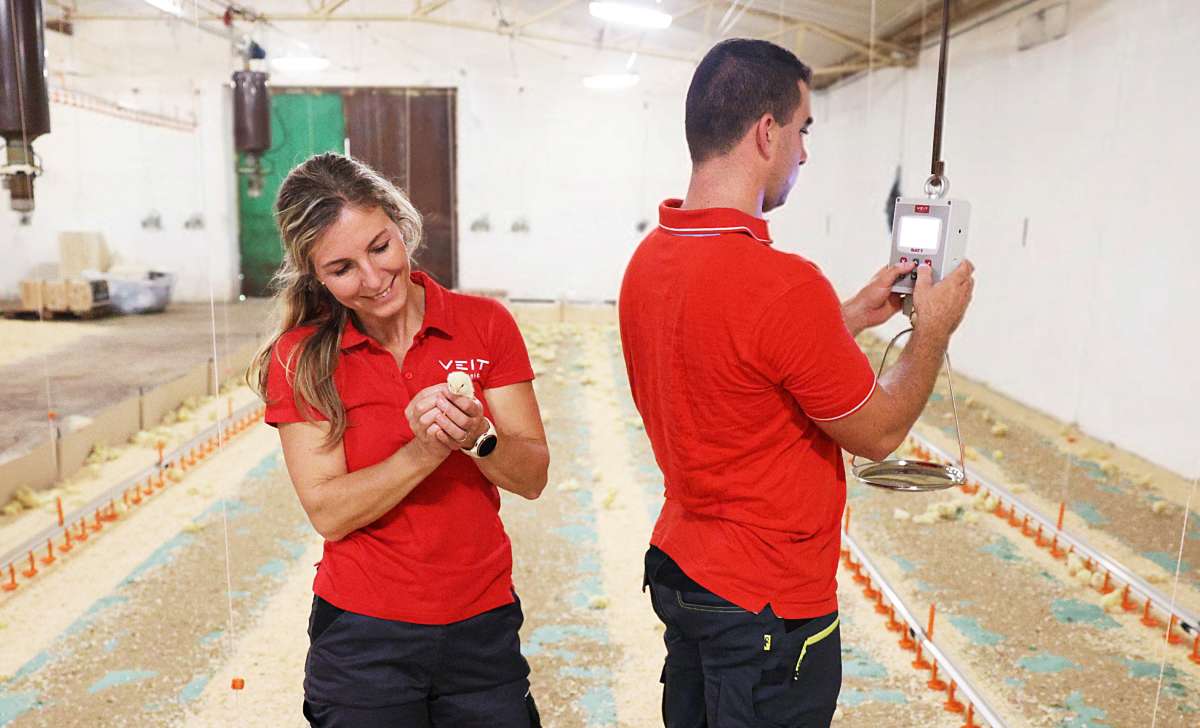
Physical handling during manual weighing sessions allows producers to collect a range of indicators that automatic systems cannot capture. Fleshing scores provide a direct measure of muscle development and body condition. Body composition and fat reserves can be assessed by touch. Early signs of disease or distress, which may not yet be reflected in weight trends, become apparent during handling. Welfare issues including foot pad dermatitis and hock burns are identifiable only through direct contact with the bird.
Major primary breeders, including Cobb and Ross, recognise this. Both recommend that regular manual weighing be conducted alongside automatic systems. The rationale is twofold: manual weighing validates automatic data collection, and it provides the direct physical contact that automation cannot replace. Even the largest and most technologically advanced poultry operations in the world maintain manual weighing protocols as part of their standard management programmes.
Handling stress: what the research found
A common concern among producers is that regular handling may introduce stress that negatively affects bird performance. The evidence does not support this. Zulkifli and Azah (2004) found that regular handling had no detrimental effect on the performance or mortality rates of commercial broiler chickens. Birds subjected to consistent human contact showed no measurable harm to production outcomes. The practical implication is significant: producers can conduct regular manual weighing sessions with confidence that the welfare and performance benefits outweigh any risk of handling-induced stress.
Manual and automatic weighing as a combined protocol
The question for most operations is not whether to use automatic or manual weighing, but how to integrate both effectively. Automatic systems provide continuous, high-frequency weight data across the flock. Manual weighing adds the physical dimension: welfare scoring, health screening, and direct observation of body condition. Together, they provide a more complete picture of flock status than either approach can deliver alone.
Efficient manual weighing also supports single-person operation, allowing multiple data points to be recorded in a single handling session while minimising bird stress. Conducted consistently, this combined approach provides the earliest possible detection of health and welfare issues before they affect flock profitability.
Sources
Sibanda, T. Z., Kolakshyapati, M., Walkden-Brown, S. W., de Souza Vilela, J., Courtice, J. M., & Ruhnke, I. (2020). Body weight subpopulations are associated with significantly different welfare, health and egg production status in Australian commercial free-range laying hens in an aviary system. European Poultry Science, 84(295). https://www.european-poultry-science.com/Body-weight-subpopulations-are-associated-with-significantly-different-welfare-health-and-egg-production-status-in-Australian-commercial-free-range-laying-hens-in-an-aviary-system,QUlEPTYzODY5NjYmTUlEPTE2MTY2Nw.html
Zulkifli, I., & Azah, A. S. N. (2004). Fear and stress reactions, and the performance of commercial broiler chickens subjected to regular pleasant and unpleasant contact with human beings. Applied Animal Behaviour Science, 88(1–2), 77–87. https://www.sciencedirect.com/science/article/abs/pii/S0168159104000656